Contact Us

Red Squirrels

Identification

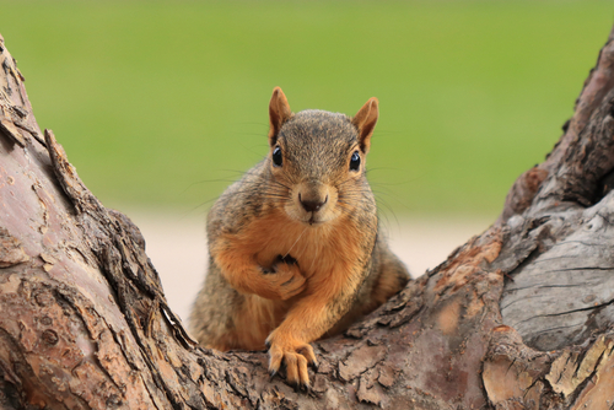
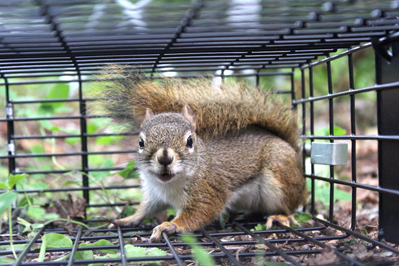
  • Red squirrels, or pine squirrels, are 11 - 14 inches long, slightly larger than chipmunks. Their fur is reddish with white on the belly.

Biology

  • Breeding period:  December-Feb, possible 2nd season in June- July
  • Gestation:  44 days
  • Birth period:  February-March, possible 2nd litter in August-September
  • Litters per year: 1-2
  • Litter size:  2-3
  • Feeding period:  Day
  • Squirrels feed on nuts, acorns, and seeds of pinecones.  They are most commonly found feeding in coniferous and black walnut trees. They love to raid bird feeders and will take just about any food that is left out for them.
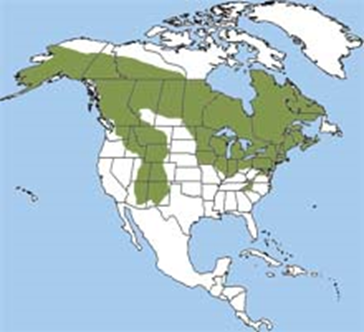
  • Range

Inspection

  • Red squirrels are a fairly common type of nuisance wildlife throughout our service territory when their habitat needs are met.  They tend to be present in areas with black walnut or coniferous trees as these are primary food sources.
  • Customers most commonly call because they are hearing noises in attics, walls, floors, etc.
  • Remember to use the information provided by the customer as a starting point for inspection. This may come from direct communication with the customer or the notes from client service detailed in the work order/proposal.
  • On initial inspection take note that common entry points may be found on the ground or roof level.
  • Common ground level entry points include vinyl siding corners, foundation vents, cracks/holes/gaps in the foundation, drainpipes, sill plate gaps and utility lines.  Red squirrels will commonly go underneath a deck to access any of these entry points.
  • Common roof level entry points include drip edge fascia gap, roof junctions, dormer corners, ridge vents, hat vents, power fans, gable vents and chimneys.
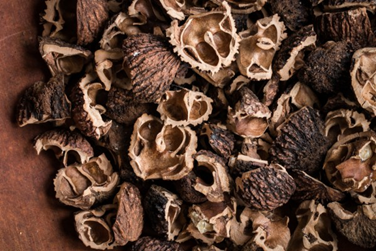
  • On the exterior look for chew marks and randomly stored walnuts on or around house.
  • When inspecting the attic look for droppings, tunneling in insulation, piles of walnuts or pinecones and chewed wires. 
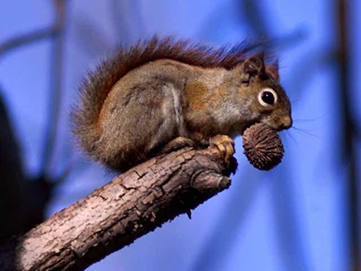
Black Walnuts Chewed by Squirrels
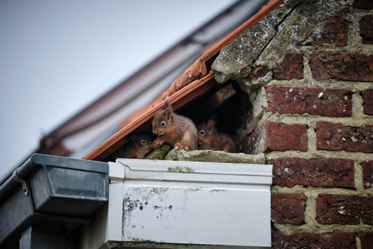
Squirrel Entry on Roof

Control

  • Trapping is the most common method of controlling red squirrels.  Lethal traps, live traps and positive control traps are commonly used.
  • Baits commonly used include peanut butter, shell peanuts, ear corn, sunflower seeds and professional baits (On-Target Squirrel Paste, On-Target Pecan, WCS TreeBerry and Jameson’s Piney Bluff).
  • Exclusion to prevent squirrels from gaining access to dwellings will also be proposed.
  • Common exclusion includes: Soffits, roof junctions, dormer corners, fascia gutter line gaps, ridge vents, soffit vents, hat vents, power fan and gable vents.
  • Spot cleaning in the attic can be proposed for areas with dropping, nests and stored food.
  • Emergency animal removal can be an option if animal is trapped in a confined area inside the living space of the home and has been seen or heard within 1-2 hours. 
  • Prevention through pruning trees can be proposed. 
  • Yard maintenance and limiting food sources such as bird feeders may be recommended.

Pro Tips

  • It is very common to find chew marks around squirrel entry points. Squirrels will even chew around pre-existing entry points.
  • When positive control trapping isn’t an option, using cracked black walnuts and Piney Bluff will increase the catch rate.
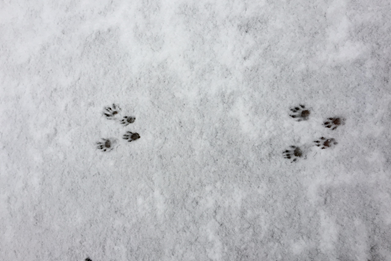
  • When trapping in the winter, follow tracks in the snow to find entry points.
  • Remember, red squirrels are the only species of squirrel that commonly enters homes at ground level so don’t forget to include this area in inspection
  • Activity reported as squirrels will often turn out to be mice in the home. Questions to ask include the time of day and what type of noises are being heard.  Squirrels are most active at dawn and dusk while mice are most active at night. Stationary noises are more likely to be mice; if running/scurrying is heard it is more likely to be squirrels.
Squirrel Tracks in the Snow